A kitchen, finally, in order.
A conversation with Mei Lin, a mother of three in Tampines, on turning a four-room HDB kitchen into a labelled system her whole family actually keeps.
In a four-room HDB flat, the kitchen works harder than any other room. It is where five people's breakfasts, three school lunchboxes and two generations' cooking styles collide in roughly eight square metres — with a service yard, a fridge and a household shelter quietly doubling as overflow storage.
Mei Lin, 38, has lived in her Tampines flat for nine years. A year ago she bought a NIIMBOT label maker to deal with what she calls "the jar problem". Since then she has printed close to four hundred labels, and her kitchen has become the one her neighbours ask about. We sat down with her over kopi to talk about what actually changed. The conversation has been lightly edited for length and clarity.

Let's start at the beginning. What did your kitchen look like before the labels?
Like every HDB kitchen, honestly. It is a galley layout, so storage goes up instead of out — the top cabinets are so high I need a step stool. And because of the humidity here, you cannot keep flour or biscuits in their original packets; everything gets decanted into airtight containers, or you are feeding the weevils. So I had this wall of identical containers, and no one — including me — could tell rice flour from corn flour from icing sugar without opening the lid.
What finally pushed you to do something about it?
Chinese New Year baking, actually. My mother-in-law came over to make pineapple tarts and used plain flour instead of top flour, because the containers look exactly the same. The tarts were a disaster, and she said, very politely, that my kitchen was impossible for anyone else to cook in. That stung, because she was right. My helper had been quietly asking me where things were for years. The kitchen only worked if I was standing in it.
So how did you begin?
One Saturday afternoon, one shelf. I did not attempt the whole kitchen — that is how people give up. I took the baking shelf first, because it caused the tart incident. I decanted, wiped everything down, then printed a label for each container from my phone: the name in large print, and underneath, the date I opened the packet. The printer itself is small enough to live in the drawer with the cling wrap. And there is no ink — it is thermal, so you load a roll and press print. That matters more than people think: if there were cartridges to run out of, I would have abandoned this by week two.
You work zone by zone?
Yes. Dry pantry first, then the spice drawer, then the fridge and freezer, then the service yard where the detergents and appliance boxes live. Even the household shelter — which, like every family in Singapore, we treat as a storeroom — the boxes of CNY decorations and the steamboat pot are all labelled now. Each zone took under an hour. The app has ready templates, so once I had designed one pantry label, the rest was just typing.


You use several different label papers. Walk us through them.
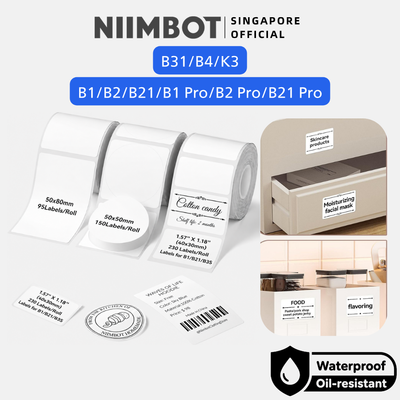
Four kinds, and each one earns its place. Plain white labels do most of the work — pantry jars, sauce bottles, the flour containers. They are waterproof and oil-proof, which sounds like marketing until you wipe down a label next to the stove after frying sambal and it still looks new. Transparent labels go on the clear canisters on the open shelving; you see the print, not the sticker, so the shelf still looks clean. Round colour stickers are for the children — each boy has his own colour, so the snack boxes and water bottles sort themselves. And freezer labels for anything that goes below zero. Ordinary stickers curl and drop off in the freezer; these are made for it.
The freezer seems to be where you are most disciplined.
Because that is where money quietly disappears! I batch-cook on Sundays — curry, soup stock, minced meat in portions. Before, everything became mystery bricks within a month, and mystery bricks eventually get thrown away. Now every container gets a label with the contents and the date, printed in ten seconds while the food cools, and we eat oldest first. We genuinely waste less food, and my trips to the wet market are shorter because I can see exactly what we already have.

A system only works if the family keeps it. Did they?
That was the surprise. My husband was the biggest sceptic and is now the heaviest user — he did the entire cable drawer and his toolbox without being asked. The boys put their own snack tins back, because the coloured sticker tells them whose is whose and where it lives. My mother-in-law cooks in my kitchen happily now; I print her labels in a bigger font so she does not need her glasses. And my helper told me the labels made her first month with us much easier — she did not have to memorise the kitchen, she could simply read it.
What would you tell someone in a new BTO or a resale flat who wants to start?
Three things. Start with one shelf, not the whole kitchen. Put a date on everything that can expire — the name tells you what it is, the date tells you whether to trust it. And keep the printer within reach of one hand; mine lives beside the cling wrap. If making a label takes more than thirty seconds, you will stop making them. If it takes ten, it becomes automatic — like wiping the counter.
Mei Lin prints with the NIIMBOT B1, which takes labels from 20 to 50 mm wide — the size she uses on her pantry jars. Every label paper mentioned in this interview is stocked locally and ships island-wide. Her starting kit is below.
Frequently asked questions.
What is the best label maker for kitchen and pantry organization? +
A compact thermal printer like the NIIMBOT B1 is ideal for kitchens: it prints 20–50 mm labels for pantry jars and containers straight from your phone, and small enough to live in a drawer.
Are NIIMBOT labels waterproof and oil-proof for kitchen use? +
Yes. The white thermal labels are waterproof and oil-proof — they wipe clean after cooking splatter instead of smearing, so they hold up next to the stove and through daily washing.
Will labels stay on containers in the freezer? +
Ordinary stickers curl and fall off below zero. Use dedicated freezer labels for batch-cooked meals — print the contents and date, and the label stays put so you always eat oldest first.
Do NIIMBOT label printers need ink? +
No. They are thermal printers, so the print comes from the label paper itself. You only ever replace the label roll — there are no ink cartridges to buy or run out of mid-task.
Mei Lin's kitchen kit.