Cafe price tags.
A conversation with Wei Jie, co-owner of a coffee bar and bakery in Everton Park, on pricing a pastry case that changes every morning.
In the ground floor of an Everton Park HDB block, Wei Jie, 33, runs a twelve-seat coffee bar with a pastry case that never looks the same two days in a row. Croissants until they sell out, a rotating bake, retail shelves of beans and drip bags roasted a few streets away. Five staff, most of them part-timers, and — until recently — a biscuit tin full of handwritten price cards.
We spoke to him at the counter before the morning rush, while he printed the day's case labels with one hand and pulled shots with the other. The conversation has been lightly edited for length and clarity.

Tell us about the biscuit tin.
Every cafe has one. Ours held maybe eighty little cards — every price we had ever written, in four different people's handwriting, some in marker, some in fountain pen because one barista had an artistic phase. Each morning someone would dig through the tin to find the card for whatever came out of the oven. If it was a new bake, someone wrote a new card, and it looked nothing like the others. The case looked like a jumble sale.
When did the tin finally lose?
The GST change. When the rate went up, every single price in the shop had to change overnight — the case, the retail shelf, the drinks list. My business partner and I sat here until midnight rewriting cards, and half of them still showed the old price the next morning because we missed them. A customer very kindly pointed out we had charged her the new price against an old card. That is not a conversation you want twice.
What does the morning look like now?
The printer lives next to the till. While the first bake cools, whoever opens prints the day's labels from the phone app — product name, price, and the allergens underneath in small print. Nuts, dairy, gluten; customers ask constantly, and now the label answers before they do. Each label takes a few seconds, the whole case takes two minutes, and every card is in the same typeface as yesterday. The case finally looks like one shop decided everything, which, funnily enough, is what a brand is.
And the retail shelf?
Beans and drip bags each get a price tag, plus the roast date — coffee people read roast dates the way aunties read expiry dates. When a price changes, we reprint one label instead of hunting through a tin. During our anniversary promotion we relabelled the entire shelf twice in one week and nobody had to stay past closing.


A bakery counter is a hostile environment for paper. How do the labels hold up?
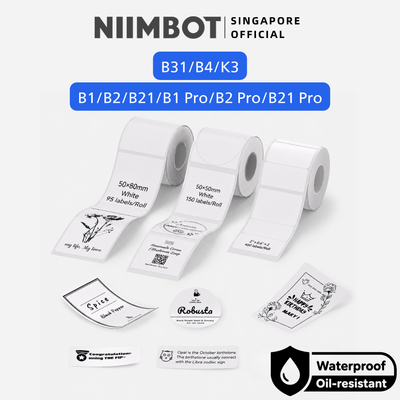
That was my first question too. The white labels are oil-proof — in a working bakery everything eventually gets a buttery fingerprint, and these wipe clean with a cloth instead of smearing. They are thermal, so there is no ink cartridge to run dry mid-service; you load a roll and print. We also keep round colour stickers by the prep fridge as date dots — every opened milk carton, every sauce bottle gets the day it was opened. The hygiene officer who inspected us actually complimented the system, which I am told does not happen often.
You run a second printer for the shelves.
The H1S, for continuous rolls. Shelf-edge strips are long and thin — a pastry card is the wrong shape for them. The continuous roll cuts to whatever length the shelf needs, so the bean shelf has one clean strip per row instead of three stickers fighting for space. Between the two printers, everything from a croissant card to a two-metre shelf run comes out of the same system.

Your team is mostly part-timers. Did the system survive them?
It survived because of them. A handwritten system depends on the one person who knows it; a printed system is just a template anyone can fill. A new part-timer learns the label routine in their first hour — open the app, pick the pastry template, type, print. When my partner and I took our first proper holiday since opening, the case looked exactly the same. That was the real test.
What would you tell another owner — a cafe, a hawker stall, a bakery — still living with the tin?
Build one template per category before you print anything: one for the case, one for retail, one for prep dates. Put allergens on the case labels; it saves your staff twenty conversations a day and it is where food labelling is heading anyway. And keep the printer at the counter, not in the back office. A label you can print without leaving the till is a label that actually gets printed.
Wei Jie prints case cards on a B21 Pro and shelf strips on the continuous-roll H1S. Every roll mentioned in this interview is stocked locally and ships island-wide. His counter kit is below.
Frequently asked questions.
What is the best printer for cafe and bakery price tags? +
A counter-sized thermal printer like the NIIMBOT B21 Pro. Print the day's case labels from the phone app in a consistent typeface — a full pastry case takes about two minutes each morning.
Are the labels oil-proof enough for a bakery counter? +
Yes. The white labels are oil-proof and wipe clean with a cloth, so buttery fingerprints don't smear the print. Being thermal, there is also no ink cartridge to run dry mid-service.
How do I print shelf-edge price strips? +
Use a continuous-roll printer like the NIIMBOT H1S — the roll cuts to whatever length the shelf needs, so each row gets one clean strip instead of several stickers.
Can one label show the price and allergens together? +
Yes — set up a template with the product name and price, and the allergens (nuts, dairy, gluten) in small print underneath. When prices change, such as a GST update, you reprint the affected labels in seconds instead of rewriting cards.
Wei Jie's counter kit.