Warehouse SKU management.
A conversation with Marcus Tan, who runs an e-commerce fulfilment floor in Kaki Bukit, on replacing 'ask Marcus' with barcodes.
Up a cargo lift in a Kaki Bukit industrial building, Marcus Tan, 38, and a team of five pick, pack and ship around three hundred orders a day for the homeware brand he co-founded — across their own web store and the major marketplaces. Eight hundred SKUs live on the racks around him: identical-looking cartons of glassware, textiles in near-identical poly bags, and hardware that differs by two millimetres of thread.
For the first two years, the warehouse management system was Marcus's memory. We spoke to him at the packing bench, under racks whose every bay now carries a barcode. The conversation has been lightly edited for length and clarity.

What does 'the warehouse was your memory' actually mean day to day?
It means every question in the building ends with my name. Where is the 40-centimetre rattan tray? Ask Marcus. Which carton is the matte glasses, not the gloss? Ask Marcus. I was the index, so I could never be sick, never fully take leave, and never scale past the size of my own recall. The boxes had handwritten labels — marker on cardboard, half of them facing the wall.
And when memory failed?
Mispicks. The worst was a week where we shipped the wrong glass set eleven times, because two SKUs shared a carton design and sat one bay apart. On a marketplace, every one of those is a return, a refund, and a one-star review that outlives the mistake. I calculated what those eleven parcels cost us in fees, shipping and ranking, and it was more than the entire labelling setup I then bought.
Describe the system that replaced you.
Location codes, the way proper warehouses do it. Every rack has a letter, every level a number, every bin a position — so the rattan tray is not 'behind the fan, ask Marcus', it is B2-04. Every bin face carries a printed label: location code, SKU, product name, barcode. The picker scans the bin, scans the item, and the two either match or they do not. Picking stopped being knowledge and became reading. My newest packer picked correctly on her first morning, which under the old system would have taken her a month of apprenticeship in the school of Marcus.
What prints all of this?
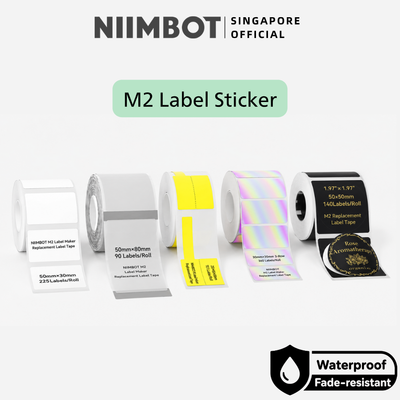
Two machines with two jobs. The B4 is the daily workhorse — wide labels up to 75 millimetres, fast, for carton labels, batch stickers and anything that lives for weeks. The M2 does the permanent work: it is thermal transfer, printing through a ribbon onto PET film, and those are the labels on the racking itself. An industrial unit like ours is not air-conditioned — it is humid, things get dragged, trolleys clip the uprights. The location labels have to outlive all of that, because the locations never change even as stock does.


You are firm about the two-printer split. Why not one machine for everything?
Because labels have lifespans, and paying for permanence on a label that lives three weeks is as wasteful as putting a paper label on a rack for three years. Direct thermal — the B4 — is fast and cheap per label, perfect for cartons that ship out and bin stickers that turn over with the stock. But direct thermal print fades with heat and friction over months. The rack locations are infrastructure, so they get PET and ribbon from the M2: scratch-resistant, waterproof, oil-proof, still crisp after two years of trolley traffic. You can tell our old labels from the surviving handwriting era — curled, grey, unreadable. Nothing printed on PET has needed replacing yet.
What happened to the mispick rate?
Eleven in a week was the old record. We now go weeks without one, and when one happens it is investigated instead of shrugged at, because the scan log shows exactly where the process broke. Stocktake went from a full weekend shutdown to cycle counts — one rack per afternoon, scan down the bays, done before the four o'clock pickup.

You mentioned the school of Marcus is closed. What changed for you personally?
I took a two-week holiday last December — my first since we founded the company — and the daily numbers did not move. That sentence took four years to become possible. The floor runs on labels and scans now, not on me, which means my job finally gets to be growing the business instead of being its search engine.
What would you tell an SME moving out of the spare room into their first industrial unit?
Label the locations before you shelve a single carton — empty racks are easy to label, full ones never get done. Put codes on the racks, not product names, because products move and renaming a rack every month is how systems die. Print the barcode even if you have no scanner yet; the label costs the same, and the day you add scanning, your warehouse is already ready. And buy the durable labels for anything you consider infrastructure. The cheap label is the one you only print once.
Marcus runs a B4 for daily carton and bin labels and an M2 with PET rolls and ribbon for permanent rack locations. Every item mentioned in this interview is stocked locally and ships island-wide. His floor kit is below.
Frequently asked questions.
What label printer should I use for warehouse bin and rack labels? +
Two machines for two jobs: the NIIMBOT B4 prints fast, wide (up to 75 mm) labels for cartons and bin faces, while the M2 thermal transfer printer handles permanent rack location labels on PET film.
Direct thermal vs thermal transfer — which do I need? +
Match the label to its lifespan. Direct thermal (B4) is fast and cheap per label — right for cartons and bin stickers that turn over with stock. Thermal transfer (M2) prints through a ribbon onto scratch-resistant PET — right for rack locations that must last years.
Can NIIMBOT printers print scannable barcodes for SKU locations? +
Yes. Print each bin face with the location code, SKU, product name and barcode — the picker scans the bin and the item, and the two either match or they don't. Picking becomes reading instead of memory, and mispicks drop sharply.
Will the labels survive a non-air-conditioned warehouse? +
The PET labels printed with ribbon are waterproof, oil-proof and scratch-resistant — still crisp after years of humidity and trolley traffic where handwritten and paper labels curl and fade.
Marcus's floor kit.