Document filing.
A conversation with Adeline Wong, who manages the paperwork of three generations from a five-room flat in Bukit Batok.
Every household in Singapore runs on paper, whether it admits it or not: IRAS letters, CPF statements, insurance policies, the children's report books, renovation warranties, and the thick envelope from HDB that no one has opened since key collection. In most flats, all of it lives in one deep drawer — and in the boxes at the back of the household shelter.
Adeline Wong, 44, works in finance and manages the documents of three generations: her own family of four, and her elderly parents' affairs two blocks away. Her study wall now holds a row of box files whose spines can be read from the doorway. We spoke to her at her dining table. The conversation has been lightly edited for length and clarity.

Describe the drawer.
You already know the drawer, because you have one. Ours was in the study: every important paper this family had ever received, in reverse order of arrival. Filing meant putting things on top. Finding meant excavation. The overflow went into shoeboxes in the household shelter, which is where paperwork goes to be forgotten — behind the CNY decorations, under the mahjong set.
What made a finance professional finally fix her own filing?
A hospital, unfortunately. When my father was warded two years ago, the ward staff asked for his insurance details, and I spent an evening on my parents' floor going through biscuit tins of documents — some older than me, in no order at all. I found the policy at midnight in a tin marked with a sticker of a rooster. I remember thinking: I build filing systems at work. My own father's medical coverage should not depend on a rooster tin.
What does the system look like?
Box files, one per subject, with a printed spine label big enough to read across the room: Tax, Insurance — Family, Insurance — Parents, House & Reno, School, Medical. The D101 prints labels up to 25 millimetres wide, which is exactly a box-file spine. Inside each box, tabbed dividers — also printed — split the subject further: inside Tax, one divider per year of assessment; inside House, one per warranty. Two levels, no more. A filing system fails the day it becomes cleverer than the person using it at eleven at night.
And the shelter boxes?
Promoted to a proper archive. Anything older than seven years but worth keeping went into archive boxes, each labelled with the contents and the year I am allowed to throw it away. That last part matters — an archive without a disposal date is just hoarding with a label on it.


Take us through the labels themselves.
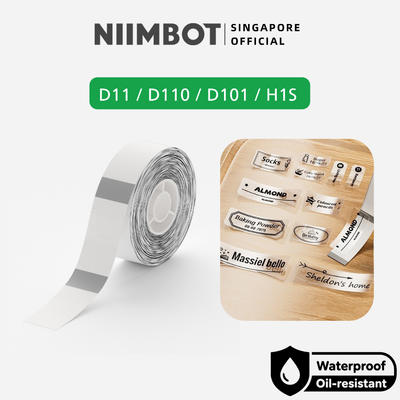
Wide white labels for the spines — high contrast, big type, the whole point is reading them from a distance. Index labels for the dividers inside; they are made for tabs, so they fold cleanly over the edge. Round colour dots mark the year: everything filed in 2026 carries the same colour, so when a box gets muddled I can re-sort by colour before I read a single word. And on the front of the insurance boxes, one extra label I consider the most valuable in the flat: next review due, with a date. Policies lapse quietly. That label does not.
You went through a surprising amount of label roll.
The whole project took two weekends and most of a value pack — the printer shares rolls across the D-series, and the multi-roll set meant I was not rationing labels halfway through my parents' tins. That is my one warning: label freely. The moment you start saving labels, you start making piles again, and the pile is the enemy.

Has the system been tested since the hospital night?
Twice, properly. During tax season my husband retrieved his own employment documents without messaging me — a first in our marriage. And when my mother needed her Pioneer Generation card details for a clinic, my father found the folder himself, because his documents now live in three labelled boxes on his own shelf, in type large enough for his eyes. That was the real success: the system survived being handed to someone who did not build it.
What should someone with a drawer do first?
Label the boxes before you sort the papers — decide the categories first, and the sorting becomes mechanical instead of emotional. Keep one in-tray for the week's mail and empty it every Sunday into the boxes; filing weekly takes minutes, filing yearly takes a weekend. And put a disposal year on everything you archive. Paper you are keeping out of vague fear is not an archive; it is the drawer again, wearing a box.
Adeline prints with the D101, whose 25 mm width fills a box-file spine, and buys her rolls in the multi-pack set. Every item mentioned in this interview is stocked locally and ships island-wide. Her filing kit is below.
Frequently asked questions.
What label maker is best for box files and document spines? +
The NIIMBOT D101 prints labels up to 25 mm wide — exactly a box-file spine — in high-contrast type you can read across the room.
How should I organise family documents at home? +
One box file per subject (tax, insurance, house, school, medical) with a printed spine label, and printed divider tabs inside — one per year or warranty. Keep it to two levels so anyone in the family can file and find.
Which labels work for divider tabs? +
Index labels — they are made for tabs and fold cleanly over the edge of a divider. Add round colour dots to mark the filing year so a muddled box re-sorts by colour.
Do the D-series printers share label rolls? +
Yes — the D11, D110, D101 and H1S share rolls, so a multi-roll value pack covers a whole-study filing project without rationing labels halfway through.
Adeline's filing kit.